Quick answer
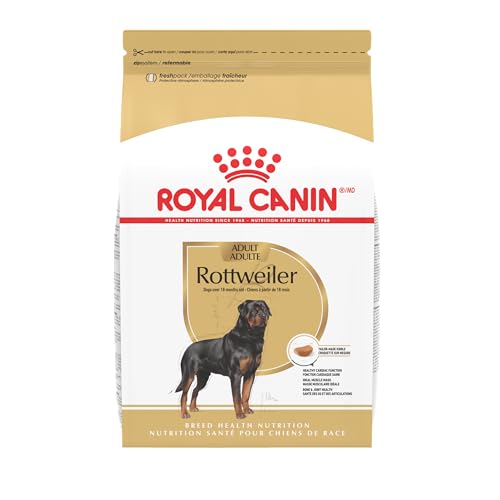
For most adult Rottweilers, our top pick is Royal Canin Rottweiler Adult Dry Dog Food, a breed-specific formula built around large breed calorie control, a kibble shape suited to a broad muzzle, and added support nutrients that may help joints carry the breed’s weight. If your Rottweiler has a sensitive stomach, Purina Pro Plan Sensitive Skin and Stomach with salmon as the first ingredient is an easier-to-digest option. On a tighter budget, Diamond Naturals Large Breed Adult delivers large breed nutrition at a lower cost per pound. For a Rottweiler puppy, choose Hill’s Science Diet Large Breed Puppy, which controls calcium and calories for steady large breed growth. Always confirm the right life stage with your veterinarian for any dog with a medical condition.
What to consider for Dry Dog Food For Rottweiler
Rottweilers are a large, dense, working breed that typically weighs 80 to 130 pounds at maturity, so the main concern is supporting a heavy frame without encouraging excess weight. Carrying extra pounds adds stress to hips and elbows, and the breed can be predisposed to joint issues such as hip and elbow dysplasia, so calorie control and steady body condition matter more than maximum protein.
Rottweiler puppies grow into a large adult size, which means controlled calcium and energy during growth may help reduce the risk of orthopedic problems tied to growing too fast. The breed is also prone to bloat (gastric dilatation volvulus) like many deep-chested dogs, so feeding measured meals rather than one large bowl, and avoiding heavy exercise right around mealtimes, is sensible. Some Rottweilers have sensitive digestion or itchy skin, where a single named protein and added omega fatty acids can help. None of this replaces veterinary advice, so talk to your veterinarian about your individual dog’s weight target and any health concerns.
What to look for in a dog food
Start with the label. Look for an AAFCO complete and balanced statement for the correct life stage, either adult maintenance for grown dogs or growth for puppies, ideally a growth statement that notes it is formulated for large size dogs (70 pounds or more as an adult). A named meat as the first ingredient, such as chicken, beef, lamb, or salmon, is preferable to a vague unnamed meat.
As practical, non-medical ranges, many adult large breed dry foods sit around 22 to 28 percent protein and 12 to 16 percent fat, with roughly 330 to 380 calories per cup, while large breed puppy foods often run a little higher in protein and calories with carefully controlled calcium near 1.2 to 1.5 percent. Choose a formula labeled for large breed suitability so kibble size and nutrient balance fit a big dog. Added glucosamine, chondroitin, and omega-3 fatty acids such as EPA and DHA may support joints and skin, though they are supportive nutrients and not a treatment. Use these as starting points and let your veterinarian set targets for any dog with a medical condition.
How we chose these picks
- Compared widely available products using publicly listed ingredients, guaranteed analysis, and feeding guidance, not personal testing
- Required an AAFCO complete and balanced statement for the relevant life stage on every pick
- Prioritized a named animal protein as the first ingredient over unnamed meat sources
- Favored formulas explicitly designed for large breed body size and calorie needs
- Looked for sensible protein, fat, and calorie levels suited to a heavy, muscular adult dog
- Gave weight to added joint and omega support relevant to a large, joint-prone breed
- Checked each brand for publicly listed recall history and current availability
- Never ranked a product higher just because it pays a commission
What to avoid
- Foods that list an unnamed generic “meat meal” as the only protein source, since you cannot tell what animal it came from
- Defaulting to grain-free or legume-heavy recipes without a reason, as the FDA investigation into a potential link between certain diets and canine dilated cardiomyopathy is ongoing and grain-inclusive is the safer default unless your veterinarian advises otherwise
- Feeding an all-life-stages or standard adult food to a large breed puppy, because uncontrolled calcium and calories can encourage growth that is too fast for big breeds
- Abrupt diet switches, which can upset digestion in a breed already prone to sensitive stomachs, so transition gradually over about 7 to 10 days
For more help, browse our dog guides, explore detailed dog food comparisons, and read up on related dog nutrition topics.


