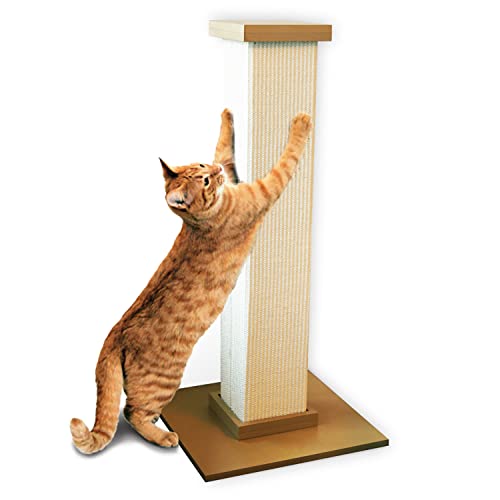
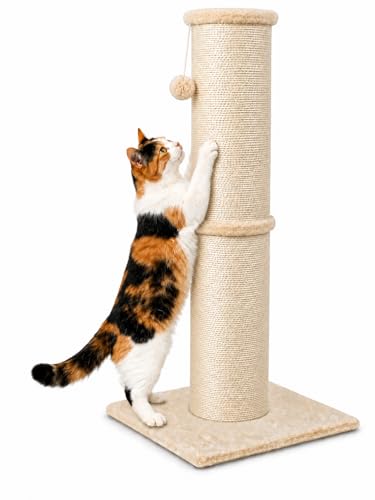
You love your cat, but you probably don’t love shredded furniture. The right scratching post can save your couch, your curtains, and your sanity. But here is the question that trips up so many owners: how thick should a scratching post actually be? The answer is not one-size-fits-all, but there is a sweet spot. Most cats need a post that is at least 3 to 4 inches in diameter. Anything thinner and they cannot get a proper claw hold, which means they will look elsewhere. Let us get into the details so you can pick the perfect post for your specific cat.
Why Thickness Matters for Your Cat’s Scratching Health
Scratching is not just a bad habit. It is a natural, essential behavior that helps your cat stretch their muscles, mark territory, and maintain claw health. When a cat scratches, they dig their front claws into the material and pull downward. This action removes the dead outer sheath of the claw. If the post is too thin, your cat’s claws wrap all the way around, and they cannot get the full pulling motion. This can lead to frustration, overgrown claws, and even behavioral issues. A post that is too thick can be hard for smaller cats to grip. The ideal thickness allows the cat to sink their claws in about halfway through the material, giving them a satisfying, full-body stretch. For most adult domestic cats, that means a post between 3 and 4 inches wide. For larger breeds like Maine Coons or Norwegian Forest Cats, go up to 5 or 6 inches.
Cats have a natural instinct to scratch on trees. In the wild, they prefer trees with a trunk diameter that matches their own body length from nose to tail base. That is why a 4-inch post works for so many indoor cats.
How to Match Post Thickness to Your Cat’s Size and Age
Kittens and Small Cats
If you have a kitten or a petite cat like a Singapura or Cornish Rex, start with a post that is 2 to 3 inches thick. Kittens are still growing, and a thinner post is easier for them to wrap their small paws around. However, do not buy a tiny post. Your kitten will grow fast. Look for a post that is at least 2 inches thick and 24 inches tall. As they grow, you can upgrade to a standard 3 to 4 inch post. A good rule of thumb: if your cat can wrap their paws completely around the post and touch their own pads, it is too thin.
Average Adult Cats (8 to 12 pounds)
This is the most common size range, and a 3.5 to 4 inch thick post is ideal. Most standard scratching posts on the market fall into this range. If you have a cat that loves to really dig in and scratch aggressively, lean toward 4 inches. If your cat is a gentle scratcher, 3 inches might work. Watch your cat’s body language. If they stretch fully and scratch for 10 to 15 seconds, the thickness is likely right. If they scratch for just a second or two and then walk away, the post might be too thin or too thick.
Large and Giant Breeds (Maine Coon, Ragdoll, Savannah)
Big cats need big posts. A 4 inch post is the bare minimum, and 5 to 6 inches is much better. These cats have larger paws and longer claws. They need a post that can handle their weight and force. A thin post will wobble or tip over, which scares them. Look for a post that is at least 5 inches in diameter and mounted on a wide, heavy base. Some owners of giant breeds even use natural logs or thick tree branches that are 6 to 8 inches across. Your cat will thank you.
A scratching post that wobbles is worse than no scratching post at all. Your cat needs to feel stable and safe to scratch with confidence.
The Relationship Between Post Thickness and Height
Thickness and height work together. A post that is the right thickness but too short will not allow your cat to fully stretch. A good scratching post should be tall enough that your cat can stand on their hind legs and reach the top with their front paws fully extended. For most cats, that means a height of at least 32 inches. If the post is 4 inches thick and only 18 inches tall, your cat will likely scratch the top edge and then move to your sofa. For kittens, a 24 inch tall post is fine, but plan to upgrade. When you are shopping, look for posts that are at least 3 inches thick and 32 inches tall. That combination works for the vast majority of cats. If you have a cat that likes to stretch horizontally, consider a flat cardboard or sisal mat instead, but for vertical scratching, height and thickness are both critical.
Material and Construction: Thickness Alone Is Not Enough
A thick post is useless if the material is wrong or the construction is flimsy. The most common and effective material is sisal rope. Sisal is rough, durable, and allows cats to really dig in. When you buy a sisal post, the thickness of the rope itself matters. Look for sisal rope that is at least 5/16 inch thick. Thinner rope frays quickly and does not give enough resistance. The post core is also important. A thick post made of cheap cardboard will collapse. Look for a solid wood core or a heavy-duty cardboard tube that is at least 1/4 inch thick. The post should be tightly wrapped with sisal, with no gaps. If you can see the core through the rope, the post is poorly made. Another option is carpet, but carpet is less effective because it does not allow claws to sink in as well. If you use a carpet post, make sure it is at least 4 inches thick and made of a looped carpet that does not snag your cat’s claws.
For more details on choosing the right material, check out our guide on best materials for cat scratching posts.
How Many Posts and Where to Place Them
Even the perfect thick post will fail if it is in the wrong spot. Cats scratch to mark territory and to stretch after sleeping. Place a post near your cat’s favorite sleeping area and another near the door or a window. If you have multiple cats, you need multiple posts. A good rule is one post per cat, plus one extra. For thickness, if you have multiple cats, go with the largest cat’s needs. A 4 inch post works for a 10 pound cat and a 15 pound cat. If you have a kitten and an adult, get a post that works for the adult and let the kitten grow into it. You can also add a smaller, cheaper post for the kitten temporarily. The key is to make scratching easy and rewarding. If your cat is already scratching your couch, place a post right in front of the scratched area. Once they use the post, you can slowly move it to a better location. Reward them with treats and praise when they use the post.
For placement tips, read our article on where to put a scratching post in your home.
Signs Your Scratching Post Is the Wrong Thickness
Your cat will tell you if the post is wrong. Watch for these signs. If your cat scratches the post but then immediately scratches the carpet or furniture, the post is likely too thin or too thick. If your cat avoids the post entirely, try a different thickness. If your cat’s claws get stuck in the material, the post might be too soft or the rope too thin. If the post wobbles or tips over, it is either too thin at the base or the post itself is too narrow for your cat’s weight. A good test: place the post on a hard floor and push it gently. If it moves easily, it is not stable enough. Finally, if your cat only scratches the top edge of the post and not the middle, the post is probably too short, not too thick. Thickness is just one piece of the puzzle.
If you are still unsure, our scratching post size calculator can help you find the perfect match for your cat’s measurements.
If your cat suddenly stops scratching altogether or starts scratching excessively to the point of damaging their claws, it could be a sign of a medical issue like arthritis or a nail infection. Please ask your vet for a checkup if you notice a sudden change in scratching behavior.