A pet air purifier earns its keep by pulling floating dander, fur, and odor out of the air before it settles on every surface, and the category is full of inflated coverage claims. We compared units rated from about 1,000 to 2,500 square feet, and the first thing we checked was whether that coverage is honest, since many purifiers cite a number based on a single air change per hour rather than the more meaningful four-to-five. True H13 HEPA media is what actually captures fine dander, so we favored sealed HEPA systems over vague filtration. We looked at odor handling for litter and wet-dog smell, filter cost over time, and washable pre-filters that catch fur before it clogs the HEPA. One important safety note for bird owners. Birds have extremely sensitive respiratory systems, and fumes from overheated nonstick coatings, scented add-ons, or ozone-generating purifiers can be dangerous to them. Choose a fragrance-free, ozone-free HEPA unit if birds share your home. For dogs and cats, match coverage to your largest room and prioritize real HEPA over big square-footage marketing.
Best Pet Air Filter (2026): 5 Top Picks Reviewed
We compared pet air purifiers from 1,000 to 2,500 square feet of coverage, judging true HEPA filtration, coverage honesty, and whether filters tackle dander and odor. We also flag a real safety point, since birds are extremely sensitive to airborne fumes, so purifier and material choice matters in b
Some links below are affiliate links. If you buy through them we may earn a small commission at no extra cost to you. Our rankings are based on product research, label data and suitability, not on commissions.
 ★ Top Pick: LEVOIT Air Purifier for Home Allergies Pet Hair in …
Quick Comparison
| Product | Best For | |
|---|---|---|
| LEVOIT Air Purifier for Home Allergies Pet Ha… | Top Pick | Check price → |
| Air Purifiers for Home Large Room up to 2200s… | Best for Large Rooms | Check price → |
| Pet Air Purifier for Home Large Room 2500 sq … | Best Washable Filter | Check price → |
| Air Purifiers for Home with High Efficiency F… | Best for Bedrooms | Check price → |
Coverage numbers are often inflated to a single air change per hour, so size a pet purifier to clean your room four to five times hourly and insist on true HEPA.
Types Explained
Large-room HEPA purifiers
High-capacity units rated for big open spaces with true HEPA media.
Best for: Large living areas with multiple shedding pets.Washable dual-filter purifiers
Models with washable filters that cut ongoing replacement cost.
Best for: Budget-minded owners wanting lower long-term filter spend.Bedroom HEPA units
Mid-size purifiers for single rooms up to about 1,000 sq ft.
Best for: Bedrooms and offices where a pet sleeps nearby.Top 4 Picks
LEVOIT Air Purifier for Home Allergies Pet Hair in Bedroom, Covers Up to 1073 ft² by 56W High Torque Motor, AHAM VERIFIDE, 3-in-1 Filter with HEPA Sleep Mode, Remove Dust Smoke Odor, Core300-P, White
The Levoit purifier covers up to 1,073 sq ft with sealed HEPA, delivering reliable dander capture and honest coverage for most living rooms.

Air Purifiers for Home Large Room up to 2200sq.ft, MOOKA Air purifier for Home Pets with Washable Filter, PM 2.5 Display Air Quality Sensor Air Cleaner for Bedroom, Dorm room, Pets, Office PR1 (White)
The Mooka purifier rated up to 2,200 sq ft suits big open spaces, pulling fur and dander from across a large area.
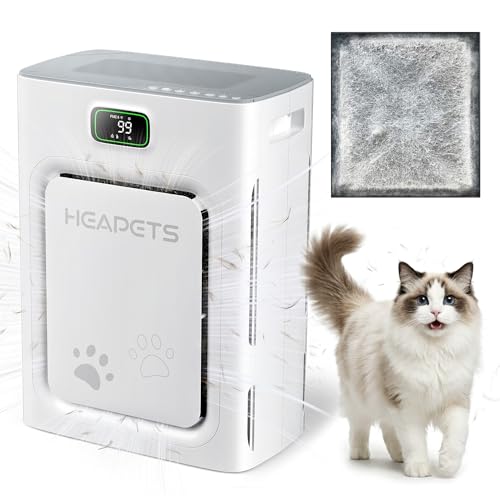
Pet Air Purifier for Home Large Room 2500 sq ft, H13 HEPA Washable Double-Sided Filter,Air Cleaner for Pet Hair Dander Odor Allergies Pollutant Smoke Dust,PM2.5 Air Quality Monitor,Auto Mode,P358 Grey
The 2,500 sq ft pet purifier with washable double-sided H13 HEPA cuts ongoing filter cost while maintaining true HEPA capture.

Air Purifiers for Home with High Efficiency Filter Up to 1076 Ft² for Pet Hair, Odors, Pollen, Smoke, Compact Air Cleaner with 3 Speeds, Timer, Aroma Quiet 360°Intake Filter, White
The high-efficiency purifier rated up to 1,076 sq ft fits bedrooms and offices, with HEPA filtration tuned for pet hair in smaller spaces.
Key Buying Factors
True HEPA filtration
H13 HEPA media captures fine pet dander that cheaper filters miss. Favor sealed HEPA systems over vague filtration claims.
Honest coverage rating
Many purifiers cite coverage at a single air change per hour. Aim for a unit rated to clean your room four to five times hourly for real dander control.
Odor and pre-filter handling
Activated carbon helps with litter and wet-dog odor. A washable pre-filter catches fur first, extending the life of the costlier HEPA filter.
Bird-home safety
Birds are extremely sensitive to airborne fumes. In bird homes choose a fragrance-free, ozone-free HEPA unit and avoid ionizers that produce ozone.
Care, Cost and Maintenance
Replace HEPA on schedule
A saturated filter stops capturing dander. Follow the maker's replacement interval, and rinse washable pre-filters often to keep fur from clogging the HEPA.
Skip ozone in pet and bird homes
Avoid ozone-generating ionizer modes. Ozone can irritate pet airways and is dangerous to birds, whose respiratory systems are especially sensitive.
Place for airflow
Put the purifier where air circulates freely, not boxed in by furniture, so it can actually pull dander from across the room.
If a bird shares your home, choose a fragrance-free, ozone-free HEPA unit, because birds have uniquely sensitive airways that airborne fumes can seriously harm.