Quick answer
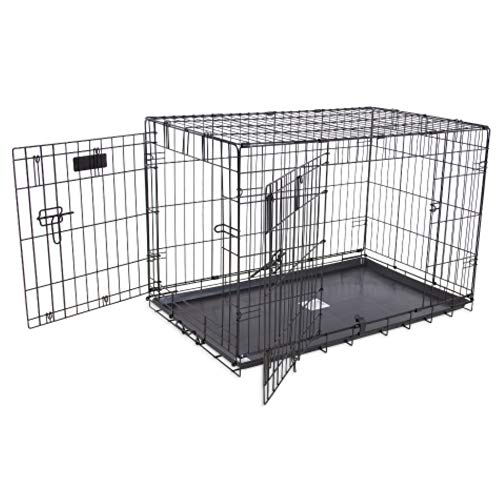
For most Labradoodles the best choice is a sturdy wire crate with a removable divider and secure slide-bolt latches. Wire gives a coated, social dog the airflow and the clear view it wants, while the divider lets you buy for the full adult size and shrink the space for a fast-growing puppy. Doodles are clever athletes, so latches that a paw or nose cannot flip matter as much as the size itself. A leak-proof tray keeps cleanup simple.
What size crate a Labradoodle needs
Labradoodles come in three rough sizes, so measure your dog rather than guessing. A Miniature around 15 to 30 pounds usually fits a 30 to 36 inch crate. A Medium around 30 to 45 pounds does well in a 42 inch crate. A Standard around 45 to 90 pounds needs a 42 to 48 inch crate. Your dog should be able to stand without ducking, turn around, and lie down fully stretched. Buy for the adult size and use the divider while a puppy grows, since doodles put on height and length quickly.
What to look for
Start with a heavy-gauge wire frame and a divider panel. Prioritize secure latches, because a bored or anxious doodle can learn to nudge a weak door open, and a strong Standard may test a flimsy one. A slide-out plastic or metal tray makes cleaning a shedding, dirt-trapping coat far easier. Rounded corners and smooth edges protect a wiggly dog, and fold-flat construction helps at home and on trips. Double doors add placement flexibility in a busy home. Add a thick washable pad so the crate feels like a comfortable den, not a bare cage, and think about airflow first for a dog wearing a warm coat.
How we chose
We focused on the traits that actually keep a Labradoodle safe and settled: correct sizing across the three weight ranges, escape-resistant latches for a smart breed, airflow and visibility for a people-oriented dog, and easy cleaning for that thick coat. We favored crates with dividers so one purchase carries a puppy to adulthood, and we included a soft travel option and an airline-style kennel for owners who move around. We also weighed how simple each crate is to fold, store, and wipe down week after week. Value and long-term durability broke any ties, since a crate that lasts through the chewing puppy months is worth more than a cheap one you replace.
What to avoid
Do not oversize a puppy without a divider, since too much room invites accidents in one corner. Skip flimsy thin-wire or weak-latch crates that a determined doodle can bend or pop open. Most important, never treat the crate as long-term confinement. Labradoodles are intelligent and prone to separation anxiety, and a dog crated too long can panic and hurt itself trying to escape. Build the crate into a positive den with patient crate training, and keep daytime stretches short.