Quick answer
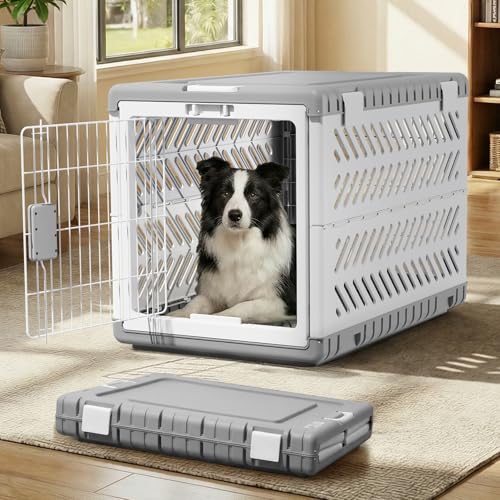
A full grown Labrador needs a large crate, usually a 42 inch model so the dog can stand without ducking, turn around, and lie flat on its side. Bigger males often do better in a 48 inch crate. Most owners are happiest with a sturdy folding wire crate for the airflow and visibility, while strong chewers and escape artists need a heavy duty steel build. For a growing puppy, buy the adult 42 inch size and add a divider panel so you can open up the space as the dog grows.
What size crate a Labrador needs
Labradors are a large breed, commonly 55 to 80 pounds, so they need real room. The rule is simple. Your dog should stand fully upright with no ducking, turn around in a full circle, and stretch out flat on one side. For most adult Labs that means a 42 inch crate, and a 48 inch crate for a tall or heavy male. If you are still house training a puppy, resist buying a small crate you will outgrow. Instead, get the 42 inch adult crate and fit the divider. Too much open space lets a puppy potty in one corner and sleep in the other, which slows house training. Move the divider back as the puppy grows.
What to look for
Airflow and visibility matter for a social breed like the Lab, which is why folding wire crates are the popular choice. Look for a slide bolt or double lock door, a removable plastic tray for easy cleaning, and rounded or reinforced corners. If your Lab chews bars or pushes at doors, step up to heavy gauge steel with a secure locking latch. For the car or the airline, a hard plastic travel kennel with side ventilation is the safer pick. A divider is close to a must have for puppy owners.
How we chose
We focused on crates sized correctly for an adult Labrador, then weighed build quality, door security, ease of cleaning, and value. We gave extra credit to models with a divider panel for puppy owners and to heavy duty builds that hold up to a determined chewer. Our picks span a folding wire crate for daily use, an airline friendly travel kennel, and reinforced steel options for escape artists. Each one leaves an adult Lab enough room to stand tall, turn in a full circle, and stretch out on one side.
What to avoid
Skip flimsy latches and thin wire if your Lab is strong or anxious, since a bent door becomes an injury risk. Do not size down to save money, because a cramped crate is uncomfortable and unfair. Most of all, remember that a crate is a safe den and a training tool, not a place to leave an active dog for long stretches. Labs need daily exercise and company, so never use the crate for all day confinement or as punishment.