๐Ÿ† Complete Buyer's Guide ยท Dog Food

Best Puppy Food For Rottweiler 2026: Top 5 Picks Compared

Find the best puppy food for Rottweilers in 2026. This guide compares 5 large-breed formulas with controlled calcium and calories for steady growth, featuring Royal Canin Rottweiler Puppy.

Some links below are affiliate links. If you buy through them we may earn a small commission at no extra cost to you. Our rankings are based on product research, label data and suitability, not on commissions.

๐ŸพNew to the breed? Read our full Rottweiler breed guide for temperament, care, health and lifespan. Royal Canin Rottweiler Puppy Dry Dog Food โ˜… Top Pick: Royal Canin Rottweiler Puppy Dry Dog Food Check Price on Amazon →
70+ lb
Adult size class that defines large-breed growth needs
1.2 to 1.5%
Typical controlled calcium range (dry matter) for large-breed puppies
26 to 32%
Common protein range for large-breed puppy food (dry matter)
7 to 10 days
Recommended gradual food transition window
โšก Key takeaways
  • Best Overall: Royal Canin Rottweiler Puppy Dry Dog Food. This breed-specific large-breed puppy formula is built around controlled calorie and calci.
  • Best Budget: Purina Pro Plan Large Breed Puppy Chicken & Rice Formula. A widely available large-breed puppy food with real chicken as the first ingredient, added.
  • Best for Sensitive Stomach: Hill's Science Diet Puppy Large Breed Chicken Meal & Oat Recipe. A consistent, grain-inclusive large-breed puppy formula with named chicken meal, controlle.
  • Best for Puppies: Eukanuba Puppy Large Breed Chicken Dry Dog Food. Designed specifically for large-breed puppy growth with chicken as a named first ingredien.
  • Best Grain-Inclusive: Diamond Naturals Large Breed Puppy Lamb & Rice Formula. A budget-friendly, grain-inclusive large-breed puppy recipe led by named lamb, with contro.
At a Glance

Quick Comparison

Quick answer

Our top overall pick for most Rottweiler puppies is Royal Canin Rottweiler Puppy Dry Dog Food, a breed-specific large-breed formula built around controlled calorie and calcium levels that aim to support a slow, steady growth rate, which is generally considered important for large-breed skeletal development. If you want a more affordable everyday option, Purina Pro Plan Large Breed Puppy is a strong value, and for puppies with a sensitive stomach our editorial team leans toward Hill’s Science Diet Puppy Large Breed. The runners-up fit better when budget, ingredient preferences, or a specific digestive sensitivity is your main priority. Always confirm the right plan with your veterinarian, especially if your puppy has a medical condition.

What to consider for Puppy Food For Rottweiler

Rottweilers are a large, heavy-boned breed that can reach 80 to 130 pounds as adults, so the central concern during puppyhood is growth rate, not just total calories. Feeding too rich a diet or letting a large-breed puppy grow too fast is widely associated with developmental orthopedic concerns, which is why large-breed puppy formulas deliberately control calorie density and calcium. Look for a food that carries an AAFCO statement specifically noting it is suitable for growth of large-size dogs (those expected to reach 70 pounds or more as adults).

Rottweilers are also prone to joint issues such as hip and elbow concerns, so recipes that include omega-3 fatty acids (often from fish oil) and sensible glucosamine support are reasonable. Their muscular build means they benefit from a named meat as the first ingredient and a moderate, not extreme, protein and fat level. Many Rottweilers can also have sensitive digestion, so a single, identifiable protein source and a recipe that agrees with your individual dog matter more than marketing claims. None of this replaces veterinary guidance for a specific health issue.

What to look for in a dog food

AAFCO statement for the right life stage. The label should say the food is complete and balanced for growth, and ideally that it is formulated for growth of large-size dogs. Avoid relying on an “all life stages” food for a large-breed puppy, since those are not always calcium-controlled for big breeds.

A named meat first. The first ingredient should be a specific named protein such as chicken, beef, lamb, or a named meat meal, not a vague “meat” or “meat by-products” with no species named.

Sensible protein, fat, and calories. As a practical, non-medical guideline, many large-breed puppy foods land around 26 to 32 percent protein and roughly 12 to 16 percent fat on a dry-matter basis, with moderate calorie density. These are general ranges, not strict rules, and your veterinarian can advise what suits your individual puppy.

Large-breed suitability and calcium control. For a Rottweiler, prioritize foods designed for large-breed growth, which typically cap calcium near 1.2 to 1.5 percent on a dry-matter basis. This is one of the most important large-breed considerations.

Joint and omega support. Omega-3 fatty acids such as DHA support development, and modest glucosamine or chondroitin can be a reasonable addition for a breed prone to joint concerns. Treat these as supportive, not curative.

How we chose these picks

  • We prioritized formulas that carry an AAFCO complete and balanced statement for growth, with a preference for large-breed growth suitability.
  • We favored recipes with a clearly named meat as the first ingredient over vague unnamed protein sources.
  • We checked that protein, fat, and calorie levels fell within sensible large-breed puppy ranges rather than extreme high-calorie profiles.
  • We looked for controlled calcium levels appropriate for large-breed skeletal development.
  • We gave weight to added DHA, omega-3 fatty acids, and joint-supportive ingredients relevant to a joint-prone breed.
  • We compared using publicly available product information, manufacturer specifications, and established nutritional guidance, not personal lab testing.
  • We reviewed each brand’s general recall and transparency history through public sources and favored manufacturers with consistent quality programs.
  • Never ranked a product higher just because it pays a commission.

What to avoid

  • An unnamed “meat meal” or generic “meat” listed as the only protein, with no species identified.
  • Defaulting to grain-free or legume-heavy recipes by default. The FDA investigation into a potential link between certain diets and canine dilated cardiomyopathy is ongoing, and grain-inclusive recipes are the safer default unless your veterinarian advises otherwise.
  • Feeding an “all life stages” food to a large-breed puppy, since these are not always calcium-controlled for big breeds during growth.
  • Abrupt diet switches. Transition foods gradually over about 7 to 10 days to reduce the chance of digestive upset.

For more help choosing, browse our dog guides, our dog food roundups, and our dog nutrition resources.

Why this matters

Rottweilers are a large breed, so the single most important nutritional factor in puppyhood is controlled calcium and calorie density to encourage slow, steady growth, which is generally associated with healthier skeletal and joint development.

The Options

Types Explained

Breed-specific large-breed puppy food

Formulas tailored to a breed, with kibble shape, calorie density, and joint support tuned for that breed's growth profile.

Best for: Owners who want a turnkey, breed-matched option and do not mind paying a premium.

General large-breed puppy food

Recipes formulated for any large-breed puppy with controlled calcium and calories, available across many price points.

Best for: Most Rottweiler puppies, especially owners balancing quality and budget.

Sensitive-stomach large-breed puppy food

Gentle, consistent recipes built around easily digestible ingredients and often a single named protein.

Best for: Puppies with loose stools, gas, or a history of digestive upset.

Grain-inclusive lamb or alternative-protein puppy food

Grain-inclusive recipes led by a protein other than chicken, useful when a puppy does better away from common proteins.

Best for: Puppies suspected of doing poorly on chicken-based diets, under veterinary guidance.
The Rankings

Top 5 Picks

#1
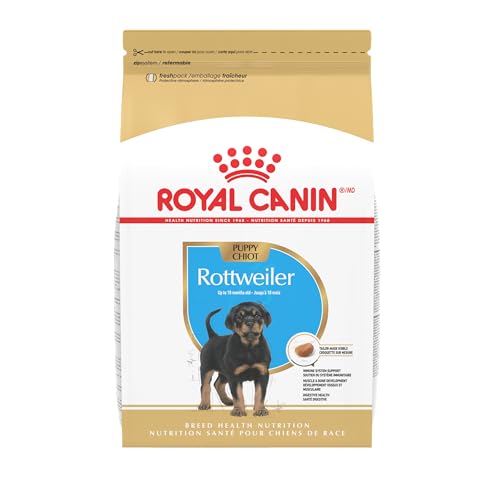
Royal Canin Rottweiler Puppy Dry Dog Food
Best Overall

Royal Canin Rottweiler Puppy Dry Dog Food

View on Amazon

This breed-specific large-breed puppy formula is built around controlled calorie and calcium levels meant to support a slow, steady growth rate, which is generally considered helpful for big breeds. It adds DHA, omega-3 fatty acids, and joint-supportive nutrients relevant to a joint-prone breed, plus a kibble shaped for the Rottweiler jaw. The honest trade-off is price, since this breed-specific formula typically costs more per pound than general large-breed options.

#2
Purina Pro Plan Large Breed Puppy Chicken & Rice Formula
Best Budget

Purina Pro Plan Large Breed Puppy Chicken & Rice Formula

View on Amazon

A widely available large-breed puppy food with real chicken as the first ingredient, added DHA for development, and a calorie profile suited to controlled large-breed growth. It carries an AAFCO growth statement and is grain-inclusive, which our editorial team views as the safer default. The trade-off is that it is a general large-breed recipe rather than Rottweiler-specific, so kibble shape and breed tailoring are not optimized for this breed.

#3
Hill's Science Diet Puppy Large Breed Chicken Meal & Oat Recipe
Best for Sensitive Stomach

Hill's Science Diet Puppy Large Breed Chicken Meal & Oat Recipe

View on Amazon

A consistent, grain-inclusive large-breed puppy formula with named chicken meal, controlled calcium for big breeds, and added DHA and omega-3 fatty acids. Many owners find its gentle, predictable recipe agrees well with puppies that have a sensitive stomach. The honest trade-off is that some Rottweiler puppies are strongly food-motivated and find the flavor less exciting than richer recipes, so palatability can vary by dog.

#4
Eukanuba Puppy Large Breed Chicken Dry Dog Food
Best for Puppies

Eukanuba Puppy Large Breed Chicken Dry Dog Food

View on Amazon

Designed specifically for large-breed puppy growth with chicken as a named first ingredient, controlled calcium, DHA for brain and vision development, and glucosamine and chondroitin for joint support that suits a joint-prone breed. It carries an AAFCO large-breed growth statement. The trade-off is that the protein and fat levels are fairly standard rather than high, so very active or working-line Rottweiler puppies may need portion adjustments under veterinary guidance.

#5
Diamond Naturals Large Breed Puppy Lamb & Rice Formula
Best Grain-Inclusive

Diamond Naturals Large Breed Puppy Lamb & Rice Formula

View on Amazon

A budget-friendly, grain-inclusive large-breed puppy recipe led by named lamb, with controlled calcium, added DHA, and probiotics for digestion. The lamb base can be a useful alternative for puppies that do better away from chicken. The honest trade-off is that quality control history across the wider Diamond manufacturing family has drawn scrutiny in the past, so review current recall information and consult your veterinarian if your puppy has specific sensitivities.

Before You Buy

Key Buying Factors

01

Large-breed growth formula

Choose a food whose AAFCO statement covers growth of large-size dogs (70 pounds or more as adults). This signals the calorie and calcium levels were set with big breeds in mind.

02

Controlled calcium

Excess calcium during rapid growth is associated with developmental orthopedic concerns in large breeds. Large-breed puppy foods typically cap calcium near 1.2 to 1.5 percent on a dry-matter basis.

03

Named meat first

A specific named protein such as chicken, beef, or lamb as the first ingredient is preferable to vague unnamed meat sources. It tells you exactly what your puppy is eating.

04

Joint and DHA support

Rottweilers are prone to hip and elbow concerns, so omega-3 fatty acids, DHA, and modest glucosamine are reasonable supportive additions. They support development rather than treat disease.

05

Grain-inclusive default

Because the FDA investigation into diet and canine DCM is ongoing, our editorial team treats grain-inclusive recipes as the safer default unless your veterinarian advises a different approach for your dog.

Living With It

Care, Cost and Maintenance

Transition foods gradually

Switch from one food to another over about 7 to 10 days, mixing increasing amounts of the new food into the old. Abrupt changes are a common cause of digestive upset in puppies.

Feed to body condition, not the bag

Bag guidelines are starting points. Adjust portions so you can feel but not see your puppy's ribs, and aim for steady, not rapid, growth. Your veterinarian can confirm an ideal body condition score.

Plan the switch to adult food

Large-breed puppies generally stay on puppy food longer than small breeds. Many Rottweilers transition to large-breed adult food around 15 to 24 months, but confirm timing with your veterinarian based on your dog's growth.

Pro tip

Confirm the AAFCO statement on the bag specifically says the food is for growth of large-size dogs (70 pounds or more), then feed to body condition rather than strictly following the bag's portion chart.

Frequently asked questions

How much puppy food should I feed a Rottweiler?
Start with the feeding chart on your chosen large-breed puppy food, which sets amounts by current weight and age, then adjust to body condition. A Rottweiler puppy should grow steadily, not rapidly, so you generally want to feel the ribs easily without seeing them. Split the daily amount into three meals while young, then two as they mature. Because every puppy's metabolism and activity level differ, treat the chart as a starting point and consult your veterinarian if you are unsure whether your puppy is gaining at a healthy pace.
How many daily calories does a Rottweiler puppy need?
Calorie needs vary widely with age, current weight, and activity, so there is no single correct number, and growing large-breed puppies need more energy per pound than adults. Rather than chasing a fixed calorie figure, our editorial team suggests following the manufacturer's large-breed puppy feeding guide and then fine-tuning by body condition over the following weeks. Overfeeding a large-breed puppy can encourage growth that is too fast, which is a real concern for the breed. Ask your veterinarian to calculate a target if your puppy seems to be gaining too quickly or too slowly.
Is grain-free food safe for a Rottweiler puppy?
The FDA has an ongoing investigation into a potential link between certain diets, often grain-free and legume-heavy, and canine dilated cardiomyopathy, and that work is not yet conclusive. Given the uncertainty, our editorial team treats grain-inclusive large-breed puppy recipes as the safer default for most Rottweilers. Grains like rice and oats are not inherently harmful and provide useful nutrition. If your puppy has a diagnosed grain allergy or your veterinarian recommends a grain-free diet for a specific reason, follow that medical advice rather than a general rule.
Does a Rottweiler puppy really need puppy food, not adult food?
Yes, puppies have different nutritional needs than adults, and large-breed puppies specifically need controlled calcium and calorie density to support steady skeletal growth. A food labeled for growth of large-size dogs is designed for this. Feeding adult food too early can shortchange development, while feeding an uncontrolled high-calorie diet can push growth too fast. Look for an AAFCO growth statement that mentions large-size dogs. Most Rottweilers stay on large-breed puppy food well past their first birthday, and your veterinarian can confirm the right time to transition based on your individual dog.
What if my Rottweiler puppy is becoming overweight?
Carrying excess weight is a real concern for a growing large breed because it adds stress to developing joints. If your puppy looks rounded, you cannot easily feel the ribs, or the waist is disappearing, reduce portions modestly and cut back on treats rather than switching foods abruptly. Keep meals measured rather than free-feeding. Because weight management in a growing puppy is different from an adult, do not crash-diet a puppy. Ask your veterinarian to assess body condition and recommend a safe target, since restricting calories incorrectly during growth can cause its own problems.
Can I feed a Rottweiler puppy senior dog food?
No, senior formulas are designed for older dogs and typically have lower calories and adjusted nutrient levels that do not match the high growth demands of a large-breed puppy. A Rottweiler puppy needs a food formulated for growth of large-size dogs with controlled calcium and adequate protein and energy for development. Senior food could leave a growing puppy underfed for its needs. Keep senior diets for the appropriate life stage. When your Rottweiler eventually ages, your veterinarian can advise whether and when a senior formula makes sense based on health, weight, and activity.
Is large-breed puppy food really necessary for a Rottweiler?
For a breed that commonly exceeds 70 to 100 pounds as an adult, large-breed puppy food is a sensible choice. These formulas control calcium and calorie density to encourage steady rather than rapid growth, which is widely considered important for large-breed skeletal and joint development. Standard or small-breed puppy foods may be more calorie-dense or higher in calcium than is ideal for a Rottweiler. Check that the AAFCO statement specifically mentions growth of large-size dogs. If you are unsure whether a given food suits your puppy's size and growth, your veterinarian can help you confirm.
Should I feed my Rottweiler puppy dry or wet food?
Both can work as long as the food is complete and balanced for large-breed growth. Dry kibble is convenient, supports dental wear, and is easy to measure, which helps with portion control for a large breed. Wet food is more palatable and adds moisture, which some puppies prefer, but it can be costlier and less practical as a sole diet for a big eater. Many owners feed dry as the base and use a little wet as a topper. Whichever you choose, confirm the AAFCO growth statement and ask your veterinarian if you have concerns.
My Rottweiler puppy has a sensitive stomach. What should I do?
Sensitive digestion is fairly common, and the first step is to slow any food transition to 7 to 10 days so the gut can adjust. Choose a consistent large-breed puppy formula with a single named protein and limited novel ingredients, and avoid frequent diet switching, which often worsens loose stools. Some recipes with added probiotics or easily digestible grains agree better with sensitive puppies. Persistent vomiting, diarrhea, blood in the stool, or weight loss are not normal and warrant prompt veterinary attention, since these can signal a medical condition that food alone will not resolve.
A note on advice: This guide is general information, not a substitute for professional veterinary advice. Talk to your vet before changing your dog's diet or care routine, especially if your dog has allergies, kidney disease, pancreatitis, obesity, heart disease or any other medical condition.
Transparency

How we made this guide

How we chose. We compared the options on the factors that matter most for Dog Food, using manufacturer specifications, aggregated verified owner reviews and editorial comparison. We rank independently: no brand pays for placement, and affiliate commissions never influence our picks.

How it was written. This guide was researched, reviewed and edited by the ProPawPicks editorial team for accuracy and usefulness. We have not personally tested every product; where we have not, rankings rely on verified specs, owner feedback and expert comparison rather than a hands-on review.

Affiliate disclosure. ProPawPicks is reader-supported. If you buy through links on our site, we may earn a commission at no extra cost to you. See our affiliate disclosure.

Keep Reading

More Dog Food guides

Stop Wasting Treats: 5 Best Interactive Dog Cameras 2026View picks โ†’Interactive Dog Toys for Boredom: Our ShortlistView picks โ†’Interactive Dog Toys, ComparedView picks โ†’Picking Invisible Dog Fence for AllergiesView picks โ†’2026 Puppy Fence Guide: 5 Top Invisible Dog Fences ReviewedView picks โ†’Best Invisible Dog Fence for Small Dogs 2026: 5 Top Picks ReviewedView picks โ†’

Sources and further reading

Some links below are affiliate links. If you buy through them we may earn a small commission at no extra cost to you. Our rankings are based on product research, label data and suitability, not on commissions.