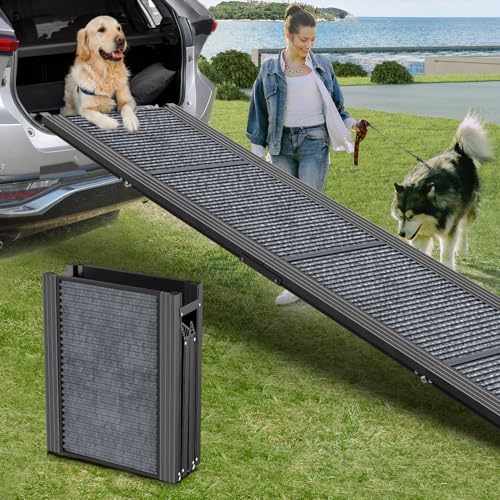
Quick answer
An SUV dog ramp lets your dog walk up into a tall vehicle instead of leaping, which protects the joints, spine, and hips from repeated high impact landings. For a tall SUV, the single most important feature is enough length so the incline stays gentle. Pair that with a high traction surface, side rails, strong weight capacity, and a stable grip at the tailgate, and choose a folding design you can actually lift and store.
Why an SUV ramp (and who needs one)
An SUV sits higher than a car, so every jump up or down is a bigger shock to a dog’s body. A ramp turns that jump into a walk. It matters most for senior and arthritic dogs, large or heavy dogs whose landings carry real force, and long backed breeds like dachshunds and corgis that are prone to disc problems. It also helps dogs recovering from surgery or injury, and small dogs facing a tailgate that towers over them. If any of these describe your dog, a ramp is joint protection you use every day.
What to look for
Start with length. A longer ramp gives a shallower, gentler incline, while a short ramp forces a steep climb that scares dogs and strains their joints. Check the weight capacity and make sure it clears your dog’s weight with room to spare, and watch for a frame that flexes in the middle. The walking surface should be genuinely non slip, and raised side rails help keep a nervous dog centered so a paw does not slip off the edge. Look for a stable grip where the top of the ramp meets the tailgate, plus a folding or telescoping build with a weight you can carry one handed.
How we chose
We prioritized the features that actually keep a dog safe and willing rather than the longest spec sheet. That meant favoring gentle incline length over a compact fold, real traction over soft carpet that mats down, honest capacity ratings with margin, and side rails and width that give an anxious dog confidence. We weighed how stable each design sits against a tailgate, since a ramp that shifts underfoot teaches a dog to distrust it. Storage weight and folded size mattered too, because a ramp that lives in the garage since it is a pain to lift never protects anyone. Above all, we favored designs a wary dog is likely to accept with a little patient training.
What to avoid
Avoid short, steep ramps sold on price, because a steep angle is the top reason dogs refuse to use one. Skip smooth or slick surfaces, wobbly frames, and capacities that barely match your dog. And remember the honest limit of any ramp: it only helps if your dog will use it. Introduce it slowly and flat first with treats, since many dogs are wary at the start. A ramp supports joints, but it works alongside keeping your dog lean and following your vet’s guidance for any existing joint or back condition.