Quick answer
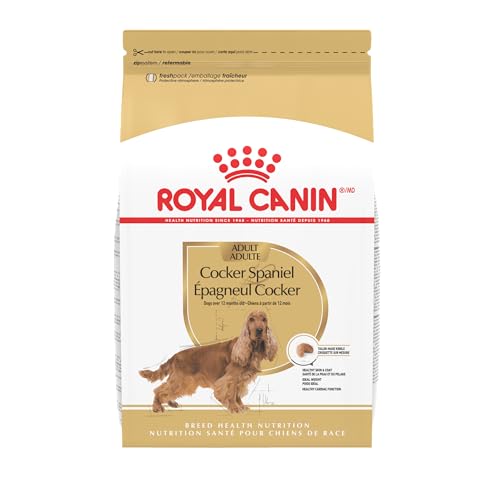
For most adult Cocker Spaniels, our top pick is Royal Canin Cocker Spaniel Adult Dry Dog Food, a breed-specific recipe built around moderate calories and coat support that suits this weight-prone breed. If your dog has a sensitive stomach or itchy skin, Hill’s Science Diet Adult Sensitive Stomach and Skin is a stronger fit. Choose Purina Pro Plan Sensitive Skin and Stomach Salmon and Rice for an omega-rich grain-inclusive option, Diamond Naturals Adult Chicken and Rice if budget matters most, and Royal Canin Cocker Spaniel Puppy for growing Cockers under 12 months.
What to consider for Dry Dog Food For Cocker Spaniel
Cocker Spaniels are a small to medium breed (roughly 20 to 30 lbs) that loves food and gains weight easily, so calorie control and accurate portioning matter more than for many breeds. They are also known for that long, silky coat and for long, hanging ears that trap moisture, which can make ear issues more common. A diet with steady, named-source fat and omega fatty acids may help support skin and coat condition, though it is not a treatment for any ear or skin disorder. The breed can also be prone to certain inherited eye and other health conditions, so if your dog has a diagnosed problem, your veterinarian should guide the diet. Kibble size suited to a small to medium mouth also helps encourage chewing.
What to look for in a dog food
Start with the label. Look for an AAFCO complete and balanced statement for the correct life stage, either “adult maintenance” or “growth” for puppies, so you know the food is formulated as a full diet. The first ingredient should be a named meat such as chicken, lamb, or salmon, not a vague “meat meal.” For a typical adult Cocker, a sensible target is roughly 22 to 30 percent protein and 12 to 16 percent fat on a dry-matter basis, with a calorie level that keeps your dog lean. These are practical ranges, not medical rules. Because Cockers are small to medium rather than large breed, large-breed puppy formulas are usually not necessary, and a smaller kibble size is easier for them to eat. Omega-3 and omega-6 support, often from fish oil or flaxseed, can be a reasonable plus for coat condition, and added glucosamine or chondroitin may support joints in older dogs, though neither is a guaranteed outcome. Always consult your veterinarian for medical conditions or before starting a supplement.
How we chose these picks
- Confirmed each food carries an AAFCO complete and balanced statement for the appropriate life stage.
- Prioritized recipes with a clearly named meat as the first ingredient over vague meat meals.
- Matched protein, fat, and calorie levels to a small to medium, weight-prone breed.
- Favored grain-inclusive recipes as the safer default while the FDA DCM investigation remains ongoing.
- Checked that kibble size and formulation suit a Cocker Spaniel’s mouth and chewing style.
- Reviewed publicly available manufacturer information and established nutrition guidance rather than personal vet testimony.
- Weighed honest trade-offs such as price, ingredient transparency, and common owner complaints.
- Never ranked a product higher just because it pays a commission.
What to avoid
- Foods that list only an unnamed “meat meal” as the protein source, with no named animal.
- Defaulting to grain-free or legume-heavy recipes. The FDA investigation into a potential link between certain diets and canine dilated cardiomyopathy (DCM) is ongoing, and grain-inclusive is the safer default unless your veterinarian advises otherwise.
- Feeding all-life-stages food to a large-breed puppy, which can disrupt controlled growth. This is less of a concern for Cockers but still worth checking the life-stage statement.
- Abrupt diet switches. Transition gradually over 7 to 10 days to reduce the risk of stomach upset.
For more help choosing, browse our dog guides, our dog food picks, and our dog nutrition resources.


