Quick answer
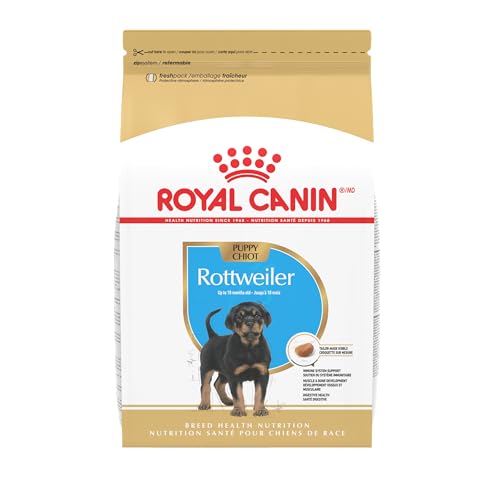
The best overall large breed dog food for Rottweiler puppies is Royal Canin Rottweiler Puppy, because it is breed-specific with tailored calcium and phosphorus levels for controlled bone growth. If your puppy has a sensitive stomach, Purina Pro Plan Focus Large Breed Puppy Chicken & Rice Formula is an excellent alternative. For budget-conscious owners, Diamond Naturals Large Breed Puppy Formula provides solid nutrition at a lower price.
What to consider for Large Breed Dog Food For Rottweiler Puppies
Rottweiler puppies grow rapidly and are prone to hip and elbow dysplasia. Their diet must support steady, controlled growth to avoid putting excess stress on developing joints. Large-breed puppy formulas have lower energy density (typically 300 to 400 kcal per cup) and adjusted calcium (around 1.0% to 1.5% on a dry matter basis) to prevent skeletal abnormalities. Protein should come from named animal sources, and fat levels should be moderate (12% to 18%) to avoid obesity. DHA from fish oil supports brain and eye development. Always choose a formula that meets AAFCO nutrient profiles for large-breed puppies.
What to look for in a dog food
Look for a statement that the food is formulated to meet AAFCO nutrient profiles for growth or all life stages, but for large-breed puppies, a specific large-breed puppy formula is ideal. The first ingredient should be a named meat, such as chicken, lamb, or fish. Protein content should be between 22% and 32% on a dry matter basis, fat between 12% and 18%. Calcium should be around 1.0% to 1.5% and phosphorus around 0.8% to 1.2% to support proper bone development. Large-breed formulas often include glucosamine and chondroitin for joint health, and omega-3 fatty acids from fish oil for skin, coat, and cognitive health. Avoid foods with excessive carbohydrates or fillers.
How we chose these picks
- We evaluated each product’s ingredient list and guaranteed analysis against AAFCO nutrient profiles for large-breed puppies.
- We prioritized formulas with named meat as the first ingredient and appropriate calcium and phosphorus levels.
- We considered the brand’s reputation for quality control and history of recalls.
- We looked for inclusion of joint-supporting nutrients like glucosamine, chondroitin, and omega-3 fatty acids.
- We assessed the calorie density to ensure it supports controlled growth without overfeeding.
- We read customer reviews to gauge palatability and digestive tolerance.
- We compared price per pound to identify value options.
- Never ranked a product higher just because it pays a commission.
What to avoid
- Avoid foods with an unnamed “meat meal” as the only protein source; always look for named meals like chicken meal or lamb meal.
- Be cautious with grain-free or legume-heavy recipes. The FDA is investigating a potential link between grain-free diets and canine dilated cardiomyopathy (DCM). Unless your veterinarian advises otherwise, a grain-inclusive formula is the safer default.
- Do not feed an all-life-stages food to a large-breed puppy, as it may have inappropriate calcium levels or calorie density.
- Avoid abrupt diet switches; transition over 7 to 10 days by gradually mixing old and new food.
For more guidance, see our dog guides, dog food, and dog nutrition sections.


