Quick answer
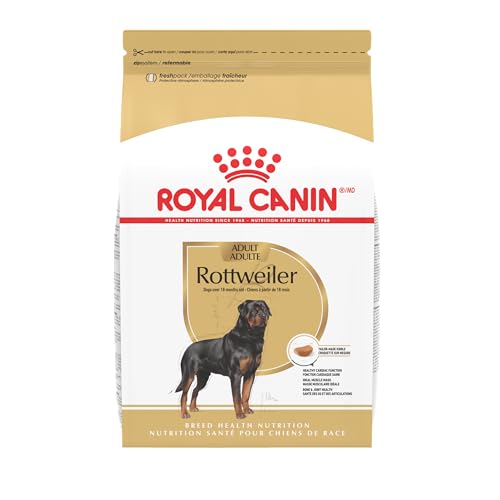
Our top overall pick is Royal Canin Rottweiler Adult Dry Dog Food, because it is built specifically around the large-breed adult Rottweiler with a controlled-calorie formula, added glucosamine and chondroitin for joint support, and a kibble shape designed for the breed’s strong jaw. If you want a widely studied alternative with a strong nutrition team behind it, Purina Pro Plan Large Breed Adult is our runner-up. For dogs with a sensitive stomach or skin, Hill’s Science Diet Adult Large Breed Sensitive Stomach & Skin fits better, while Diamond Naturals Large Breed Adult is the value choice and Royal Canin Large Breed Puppy covers growing Rottweiler pups.
Why Rottweilers need the right food
Rottweilers are a giant-leaning large breed, with adult males often reaching 95 to 135 pounds and females 80 to 100 pounds. That size shapes almost every feeding decision. As a deep-chested breed, they carry an elevated risk of gastric dilatation-volvulus, commonly called bloat, so meal timing and avoiding heavy exercise around meals matter as much as the food itself.
The breed is also predisposed to orthopedic problems, including hip and elbow dysplasia and cruciate ligament issues, which is why controlled calories, a lean body condition, and joint-support nutrients like glucosamine, chondroitin, and omega-3 fatty acids are valuable. Excess weight is one of the biggest avoidable stressors on a Rottweiler’s joints and heart, so calorie density and portion control are central.
Rottweilers are muscular, high-energy working dogs that benefit from moderate to high quality protein to maintain lean muscle, paired with measured fat so they do not gain weight when activity drops. Some individuals have sensitive stomachs or skin and do better on a limited, consistent ingredient set. The breed is also among those flagged in the FDA’s ongoing diet-related heart investigation discussion, so heart-healthy nutrition and a grain-inclusive default are worth considering. As always, activity and body condition matter more than one fixed number.
What to look for in a Rottweiler food
Start with an AAFCO statement confirming the food is “complete and balanced” for the right life stage, either adult maintenance or, for puppies, growth of large-size dogs. For a growing Rottweiler, a large-breed puppy formula with controlled calcium is important to support steady, not rushed, bone growth.
Look for a named animal protein as the first ingredient, moderate protein in roughly the 22 to 28 percent range for adults, and controlled fat so calories stay in check. Joint-support ingredients such as glucosamine, chondroitin, and EPA and DHA omega-3s are a genuine plus for this breed. A reasonable calorie density helps you manage weight, and a larger kibble size suits the breed’s strong jaw and may slow eating slightly. We treat grain-inclusive recipes as the safer default unless your vet advises otherwise.
Find the right food for your dog’s needs
The picks above suit a healthy adult Rottweiler. For a specific life stage or health need, use these focused guides.
- Puppies: see our guide to the best Rottweiler food for puppies.
- Seniors: see our guide to the best Rottweiler food for senior dogs.
- Sensitive stomachs: see our guide to the best Rottweiler food for sensitive stomachs.
- Skin allergies: see our guide to the best Rottweiler food for skin allergies.
Which food type is best?
Dry, wet, fresh, raw and dehydrated foods can all work for a Rottweiler. The right one depends on your budget, your dog’s preferences and any health needs.
- Dry: most economical and convenient, and the crunch helps clean teeth.
- Wet: higher moisture and often more palatable, useful for fussy eaters or as a topper.
- Fresh and gently cooked: minimally processed with recognisable ingredients, at a higher cost.
- Raw and freeze-dried raw: high protein and minimally processed; handle safely and ask your vet first.
Getting the best value
The cheapest bag is not always the best value. A quality food that keeps your Rottweiler lean, with a healthy coat and firm stools, often means fewer vet visits. Feed to a healthy body condition rather than the bag maximum, and choose a recipe built around quality animal protein.
How we chose these foods
- Confirmed each food carries an AAFCO “complete and balanced” statement for the correct life stage
- Prioritized large-breed or breed-specific formulas suited to a Rottweiler’s size and joint needs
- Checked for a named animal protein source and moderate, muscle-supporting protein levels
- Favored recipes with controlled calories and added joint support such as glucosamine and chondroitin
- Reviewed each brand’s published nutrition expertise, manufacturing control, and feeding research
- Cross-checked the FDA animal food recall list and treated grain-inclusive recipes as the safer default
- Considered real-world fit, including options for sensitive stomachs, puppies, and tighter budgets
- Never ranked a food higher just because it pays a commission
Foods to avoid or feed with care
- Generic small-breed or all-life-stages formulas that are not calorie-controlled for a large breed, which can drive unwanted weight gain
- Grain-free or legume-heavy diets fed by default, given the FDA’s ongoing diet-related heart investigation, unless your vet specifically advises one
- High-calorie performance or puppy foods fed to a low-activity adult, which can push a Rottweiler over a healthy weight
- Adult maintenance food fed to a fast-growing large-breed puppy, since large-breed pups need controlled calcium and calories for steady bone growth
- Foods with vague, unnamed protein sources or no AAFCO statement, which make it hard to judge quality
- Rich table scraps and sudden diet switches, which can upset a sensitive stomach and, in a deep-chested breed, are worth avoiding around bloat-risk windows
For more, browse our dog food guides, our dog nutrition hub, and our dog health articles to match the right formula to your individual dog.


