Quick answer
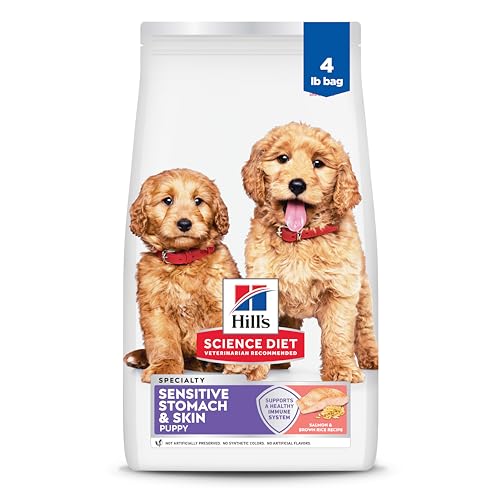
For most Beagle puppies, our top pick is Purina Pro Plan Puppy Chicken & Rice Formula, a grain-inclusive recipe with real chicken as the first ingredient and an AAFCO statement for growth. It supports a sturdy small to medium build without the legume-heavy profile some Beagle owners want to avoid while the FDA DCM investigation is ongoing. If your puppy has a sensitive stomach, Hill’s Science Diet Puppy Sensitive Stomach & Skin is a better fit. On a tighter budget, Diamond Naturals Puppy Formula delivers a named meat first at a lower cost per pound, and Royal Canin Beagle Puppy suits owners who want a breed-shaped kibble and Beagle-tuned portioning.
What to consider for Puppy Food For Beagle
Beagles are a scent hound bred to eat enthusiastically, and they are one of the breeds most predisposed to overeating and obesity. That makes calorie control and accurate portioning the single most important factor for a Beagle puppy, more so than for many other breeds. A free-fed bowl is a real risk here, so a food with clear feeding charts by current weight and projected adult weight helps you avoid overfeeding.
Beagles mature into a compact small to medium dog, typically reaching 20 to 30 pounds as adults, so they generally do well on standard puppy or all-breed growth formulas rather than large-breed puppy food. Their relatively small mouths can manage small to medium kibble, and many Beagle puppies eat fast, so kibble size and shape that encourages slower eating can help. Beagles can also be prone to ear and skin issues and occasional digestive sensitivity, so a recipe with sensible fat and named protein, plus omega support, is a reasonable goal. Always consult your veterinarian about your individual puppy, especially if you notice loose stool, itching, or rapid weight changes.
What to look for in a dog food
Start with the label. Look for an AAFCO complete and balanced statement for growth (or for “all life stages”), which tells you the food is formulated as a sole diet for a puppy rather than as a treat or supplement. Next, check that a named meat appears as the first ingredient, for example chicken, chicken meal, lamb, or salmon, rather than a vague “meat meal” or an unnamed by-product as the only protein.
For a growing Beagle, practical targets are roughly 22 to 32 percent protein and about 12 to 18 percent fat on a dry-matter basis, with calorie density that lets you feed a satisfying portion without overfeeding. These are general ranges, not medical rules, and the right numbers for your puppy depend on age, activity, and body condition, so treat them as a starting point to discuss with your vet. Because Beagles are a small to medium breed, a standard or small-breed puppy formula is usually appropriate, not large-breed puppy food, which is calibrated for slower-growing giant breeds. Finally, omega-3 fatty acids (such as DHA from fish oil) support normal brain and coat development, and that is a sensible feature to look for in any puppy food.
How we chose these picks
- We prioritized recipes carrying an AAFCO complete and balanced statement for growth or all life stages.
- We favored foods with a clearly named meat or named meat meal as the first ingredient.
- We matched each pick to a Beagle’s small to medium size, choosing standard or small-breed puppy formulas over large-breed growth food.
- We checked that protein, fat, and calorie levels fell in sensible ranges for an active, weight-prone puppy.
- We looked for omega-3 or DHA support relevant to a growing puppy’s coat and development.
- We weighed honest, publicly reported owner feedback and common complaints rather than marketing claims.
- We compared using publicly available product information and established nutrition guidance, not personal veterinary endorsement or hands-on research.
- Never ranked a product higher just because it pays a commission.
What to avoid
- An unnamed “meat meal” or generic “animal by-product” listed as the only protein source, since you cannot verify the species or quality.
- Defaulting to grain-free or legume-heavy recipes without a reason. The FDA investigation into a potential link between certain diets and canine dilated cardiomyopathy (DCM) is ongoing, and grain-inclusive food is the safer default for most puppies unless your veterinarian advises otherwise.
- Feeding an all-life-stages food formulated for a large-breed puppy, which can carry mineral and calorie levels calibrated for giant breeds rather than a compact Beagle.
- Abrupt diet switches, which commonly cause loose stool. Transition over about 7 to 10 days by gradually mixing in more of the new food.
For more help, browse our dog guides, compare options in dog food, and read up on feeding fundamentals in dog nutrition.