Quick answer
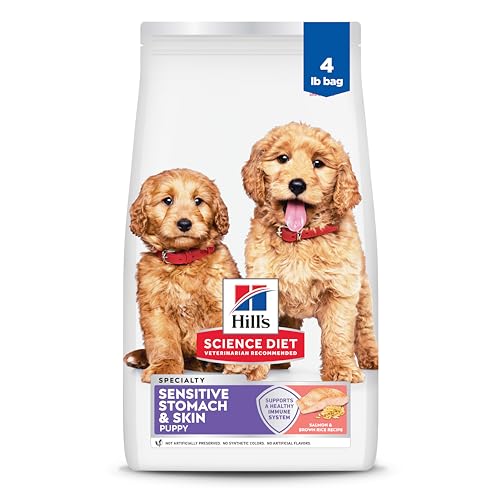
Our top pick is Purina Pro Plan Puppy Sensitive Skin & Stomach Salmon & Rice Formula. It’s a well-balanced, chicken-free recipe with salmon as the first ingredient, easily digestible for sensitive tummies, and backed by decades of research. For a budget-friendly option, Diamond Naturals Puppy Formula Real Lamb & Rice offers solid nutrition at a lower price point. If you prefer a grain-inclusive recipe with added joint support, Hill’s Science Diet Puppy Healthy Development Salmon & Brown Rice is an excellent choice.
What to consider for Puppy Food Without Chicken
Puppies have unique nutritional needs for rapid growth and development. When choosing a chicken-free puppy food, ensure it meets AAFCO nutrient profiles for growth. Look for a named animal protein source (like salmon, lamb, or duck) as the first ingredient. Avoid foods with unnamed “meat meal” or vague protein sources. Consider your puppy’s breed size: large-breed puppies need controlled calcium and phosphorus levels to support proper bone development. Also, check for DHA from fish oil to support brain and eye development. If your puppy has a sensitive stomach or skin issues, a limited-ingredient diet may help.
What to look for in a dog food
First, confirm the food has an AAFCO statement indicating it is “complete and balanced” for growth or all life stages. The first ingredient should be a named meat or fish (e.g., salmon, lamb, deboned chicken is not allowed here). Protein content should be around 22 to 32% on a dry matter basis, fat around 8 to 20%, and calories around 350 to 450 kcal per cup, but these are general ranges; follow your vet’s advice. For large-breed puppies, ensure calcium is around 0.8 to 1.2% and phosphorus is appropriately balanced. DHA from fish oil is beneficial for cognitive development. Omega-3 and omega-6 fatty acids support skin and coat health. Avoid artificial colors, flavors, and preservatives.
How we chose these picks
- Evaluated ingredient lists to ensure no chicken or chicken by-products.
- Verified AAFCO nutritional adequacy statements for growth or all life stages.
- Selected products from brands with a history of rigorous quality control and research.
- Considered protein sources that are less likely to trigger food sensitivities.
- Checked for appropriate calcium-to-phosphorus ratios for large-breed puppies where applicable.
- Read customer reviews for palatability and digestive tolerance.
- Compared price per pound to offer options at different budgets.
- Never ranked a product higher just because it pays a commission.
What to avoid
- Avoid foods where the primary protein source is an unnamed “meat meal” or “poultry meal” (could include chicken).
- Be cautious with grain-free or legume-heavy recipes; the FDA is investigating a potential link to canine dilated cardiomyopathy (DCM). Grain-inclusive diets are generally safer unless your vet advises otherwise.
- Do not feed an “all life stages” food to a large-breed puppy, as it may have inappropriate calcium levels.
- Avoid abrupt diet switches; transition over 7 to 10 days by gradually mixing old and new food.
For more guidance, check out our dog guides, dog food, and dog nutrition sections.