Quick answer
Our top pick is Royal Canin Large Breed Puppy Wet Food because it meets WSAVA guidelines, provides balanced calcium for controlled bone growth, and has the right calorie density for large breed puppies. If your puppy has a sensitive stomach, Hill’s Science Diet Large Breed Puppy Chicken & Rice is a great alternative. For a budget-friendly option, Purina Pro Plan Large Breed Puppy Chicken & Rice delivers solid nutrition at a lower price.
What to consider for Wet Dog Food For Large Breed Puppies
Large breed puppies (breeds expected to weigh over 50 pounds as adults) have unique nutritional needs. They grow rapidly and are prone to skeletal issues like hip dysplasia and osteochondrosis. Wet food can be beneficial because it provides extra moisture, which supports hydration and kidney health. However, wet food typically has fewer calories per volume than dry food, so you must ensure your puppy gets enough calories and nutrients. Look for foods that meet AAFCO nutrient profiles for growth and are specifically formulated for large breed puppies. These formulas have controlled calcium (around 1.0% to 1.5% dry matter) and phosphorus levels, and a calorie density appropriate for large breed growth rates. Avoid all-life-stages foods, as they may not have the right balance for large breed puppies.
What to look for in a dog food
When choosing a wet dog food for your large breed puppy, start by checking the AAFCO statement: it should say “complete and balanced for growth” or “all life stages” (though all-life-stages may not be ideal for large breed puppies). The first ingredient should be a named meat source like chicken, beef, or lamb. Protein content should be around 8% to 12% on an as-fed basis (roughly 30% to 40% dry matter). Fat should be around 4% to 8% as-fed (15% to 25% dry matter). Calorie density should be between 350 and 450 kcal per can (13 oz) or about 90 to 130 kcal per 100 grams. Look for controlled calcium (0.8% to 1.5% dry matter) and phosphorus (0.6% to 1.2% dry matter). DHA from fish oil supports brain and eye development. Glucosamine and chondroitin can help joint health. Avoid formulas with excessive carbohydrates or fillers.
How we chose these picks
- We evaluated products based on nutritional adequacy for large breed puppies per AAFCO guidelines.
- We prioritized brands that meet WSAVA global nutrition recommendations (conduct feeding-data reviews, employ a nutritionist, publish research).
- We checked ingredient lists for named meat sources and avoided unnamed meat meals.
- We compared calcium, phosphorus, protein, fat, and calorie levels to ensure they are appropriate for large breed growth.
- We considered the presence of DHA, glucosamine, and chondroitin for developmental and joint support.
- We read customer reviews for palatability and digestive tolerance.
- We factored in price per can and availability.
- Never ranked a product higher just because it pays a commission.
What to avoid
- Avoid foods where the primary protein source is an unnamed “meat meal” or “poultry meal” because the source is unclear and quality may vary.
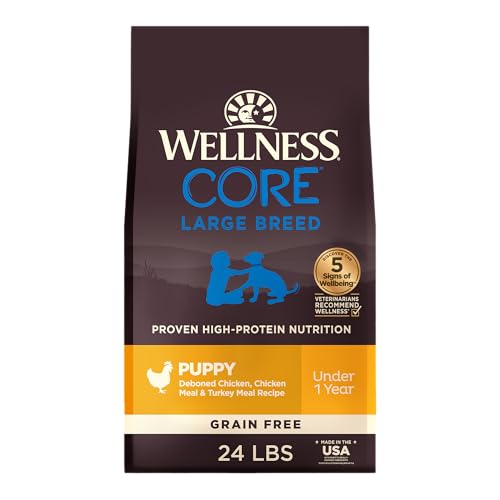
- Be cautious with grain-free or legume-heavy recipes. The FDA is investigating a potential link between these diets and canine dilated cardiomyopathy (DCM). Unless your vet advises otherwise, choose a grain-inclusive formula.
- Do not feed an “all life stages” food to a large breed puppy unless it specifically meets large breed puppy nutrient profiles. All-life-stages foods may have inappropriate calcium levels.
- Avoid abrupt diet switches. Transition over 5 to 7 days by mixing increasing amounts of new food with old food to prevent digestive upset.
For more guidance, see our dog guides, dog food, and dog nutrition categories.