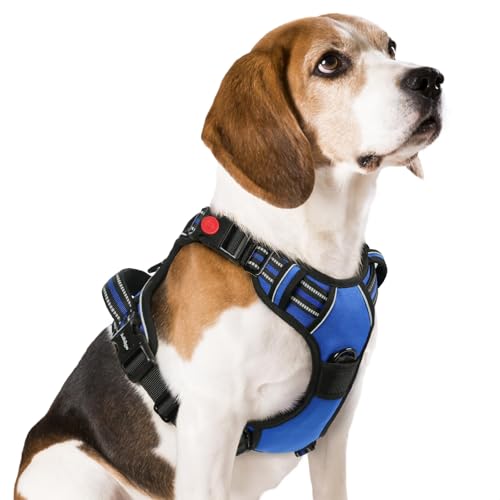
Quick answer
Our top pick for deep-chested dogs is the Ruffwear Load Up Harness, designed specifically for car travel with a broad chest strap and padded belly panel. It secures via a seatbelt loop and has a low-profile buckle that avoids pressure on the sternum. For budget-conscious owners, the Rabbitgoo Car Harness offers a similar fit at half the price, while the Kurgo Tru-Fit provides a crash-tested option with multiple adjustment points.
What to consider for Dog Car Harness For Deep Chested Dogs
Deep-chested breeds (e.g., Great Danes, Irish Wolfhounds, Standard Poodles) have a narrow, deep ribcage that makes standard harnesses slip or press uncomfortably on the sternum. A proper car harness must have a wide, padded chest plate that distributes force across the breastbone, not the throat. Look for a design with a low front ring or a Y-shaped front that avoids the trachea, and a belly strap that sits behind the elbows to prevent chafing. Crash-test certification (e.g., Center for Pet Safety) is ideal, but any harness with a metal seatbelt loop and strong buckles can provide basic restraint. Also consider ease of entry: a step-in style is easier for dogs that dislike overhead harnesses.
What to look for in a gear item (harness, collar, leash or muzzle)
Correct fit and sizing: Measure your dog’s chest girth behind the front legs and the length from the base of the neck to the base of the tail. Many harnesses have size charts that include deep-chested proportions. Durable hardware and materials: Look for metal D-rings and buckles, not plastic, and reinforced stitching. Nylon webbing is standard, but neoprene padding adds comfort. Safety features: Choose a harness with a seatbelt loop that attaches to the car’s latch system. Reflective stitching or trim improves visibility. Ensure the harness is escape-proof: no-slip design with a martingale loop or a second belly strap. Comfort and padding: A padded chest plate and belly strap prevent rubbing. Avoid harnesses that restrict shoulder movement. No-pull design: Front-clip harnesses can help manage pulling, but for car use, a rear-clip or dual-clip is better for restraint.
How we chose these picks
- We evaluated each harness for fit on deep-chested body types using manufacturer size charts and customer feedback.
- We prioritized crash-test certified models when available, but also considered budget-friendly options with robust construction.
- We checked for adjustable straps that allow a custom fit around the chest and belly.
- We read hundreds of verified buyer reviews to identify common fit issues for deep-chested dogs.
- We considered ease of use: quick-release buckles, step-in designs, and compatibility with seatbelt systems.
- We compared prices across major retailers to ensure value.
- We excluded any harness with a front attachment that could put pressure on the trachea.
- Never ranked a product higher just because it pays a commission.
What to avoid
- Avoid harnesses with a single strap across the chest that can dig into the sternum or slip sideways.
- Steer clear of plastic buckles and clips that may break under sudden force during a car stop.
- Do not use aversive tools like prong collars or choke chains for car restraint; they can cause injury in a crash.
- Never use a retractable leash attached to a harness inside a car, as it can tangle or fail to restrain the dog.
For more gear guidance, check our dog guides and explore dog care products or dog health resources.